Every company needs permission to experiment. Or, at least, someone in charge.

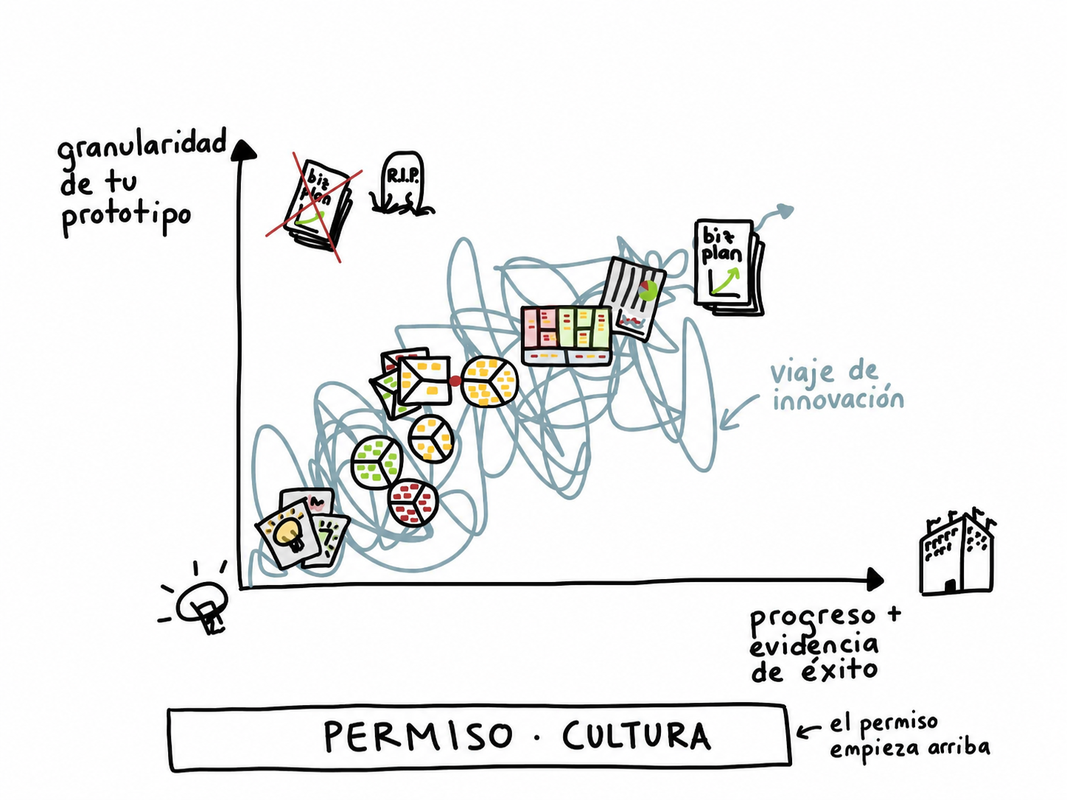
A company's best ideas rarely die in a meeting, they get stuck because testing them isn't anyone's job. On why every company needs permission to experiment, or at least, someone in charge.
There are good ideas that never get past being ideas, not because they're bad, but because no one is assigned to them, and there are also the ones no one ever says out loud, because they sound too crazy to raise your hand for.
The problem is almost never the idea, those are everywhere and in every form. The problem is that the missing step is the one that goes from "I have an idea" to "this works". And that step, which is experimenting, is almost never anyone's job.
That's why so many end up in the same place, on slide 14 of a PowerPoint, forever.
Where this comes from
In "Every Company Needs a Head of Experimentation", Zevae Zaheer argues that companies need a role dedicated to experimenting, the same way they started needing innovation managers a few years ago.
For me, the problem isn't solved just by hiring someone, a role helps, but what's really missing is simpler and more uncomfortable. Permission.
Permission to try something with no guarantee it'll work, permission to spend a little time and money validating before committing to everything, permission to fail without it being a career-ending event.
Without that permission, you can hire the best Head of Experimentation in the world, and they'll end up making… PowerPoints.
Innovate, experiment, scale (not the same thing)
It helped me to separate three things we tend to blur together.
- Innovating is having the ideas, it's creating the potential value.
- Experimenting is validating whether that value is actually real, it's the mechanism that separates "sounds good" from "works".
- Scaling is capturing that value once you've proven it.
Innovation without experimentation is pretty ideas with no evidence, and experimentation without permission is theater.
What I've seen work
When permission exists, some things repeat.
- Validate fast and cheap, understanding that fast is relative, with users and short cycles it can be days, but with something physical or more complex it can be months, what matters isn't speed but spending the minimum before you know it's worth it, and it's not about failing fast for sport, it's about not committing to everything without evidence.
- Define what success is before you start, because if you don't know what you'd measure, it isn't an experiment, it's a hunch with a budget.
- The teams on your side, because an experiment the rest of the company sees as a threat doesn't get far, no matter how good the idea is.
And there's the hardest part, which isn't technical but human, the people, because resistance to change kills more experiments than any miscalculation, but that's worth a whole other post like this one.
Who is it for, and whose culture is it?
This isn't just for senior leadership, the role serves the whole company, from the executive office to the business units and even support functions like finance or HR, and while not everyone has to innovate, almost anyone can experiment in their own work.
And then there's culture, which is where it really gets complicated, because you can have every intention of changing something through experimentation, but if the culture won't let you, that's as far as it goes, and a culture isn't created by a job title, it's granted, or not, by the people in charge.
And there's something else, which maybe is also culture, or maybe is something else, relationships. An experiment is almost never neutral, depending on what you test you might end up improving an area, expanding a department or changing its functions, and sometimes, if it goes well, redefining what someone was already doing, or opening a business line that ends up being someone else's job. That's why people don't just resist change out of fear, they resist because the experiment touches their turf, and that, which is kind of political, is something I'll get into in another one of these posts.
Executives almost always have good intentions, but intention isn't permission, someone in charge of experimentation can push, teach, lead by example, what they can't do is grant themselves the permission that only leadership gives.
So, whose culture is it? The experimentation lead's? The innovation manager's? Or is it something bigger, that no title can carry on its own? Honestly, I don't have it figured out, but I have a hunch, the culture belongs to everyone, and permission starts at the top.
So, role or permission?
If you can, name someone in charge of experimentation, really, it helps, someone has to own that ideas get tested and don't just stay on the slide.
But first, ask yourself something more uncomfortable. Does your company have permission to experiment?
I work better when I have that permission, and sometimes I've given it to myself, but in a good world, I'm not the only one who has it, it's the whole company.
Because good ideas don't die because they're bad. They die waiting for permission.
This is the first in a series. In the next ones I get into the human factor and resistance to change, how everything changes depending on the type of company, and why an MVP is almost never a version 1. If you want to follow the thread, follow me or subscribe to the newsletter.
Inspired by Zevae Zaheer's article, "Every Company Needs a Head of Experimentation". Diagram adapted from Intuit Design.